Created by: Eri Brito
The Yellow Wallpaper
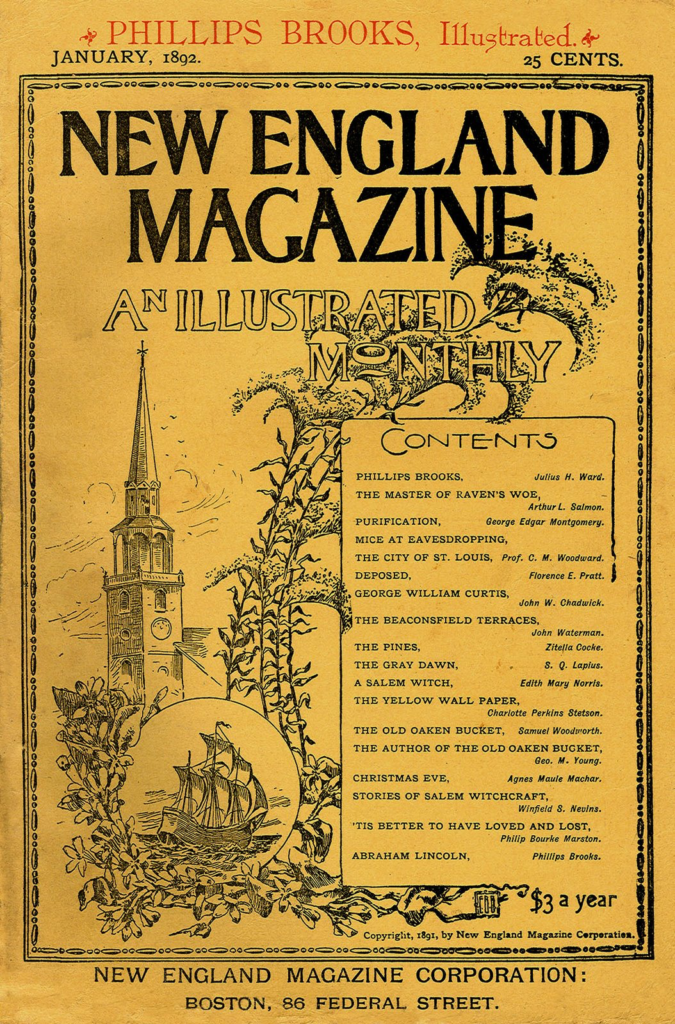
“The Yellow Wallpaper,” written by Charlotte Perkins, is a short story published in January 1892 in The New England Magazine. This story follows the experience of our unnamed narrator, who is taken to a rented colonial mansion for the summer to recover from what her physician husband John calls “Temporary nervous depression — a slight hysterical tendency” (Gilman 1). While confined in an upstairs nursery, along with barred windows and a strange yellow wallpaper, the narrator is forbidden from working and writing while in complete rest. As the story progresses, she becomes obsessed with the unusual patterns in the wallpaper, eventually leading her to believe that she sees a woman trapped behind it. By the end, the narrator has ascended into a complete state of madness, tearing down the wallpaper and “creeping” over her fainted husband’s body.

Charlotte Perkins Gilman was an American author and a prominent advocate for women’s rights in the late nineteenth century. In 1887, following the birth of her daughter, Gilman suffered from what we know today as postpartum depression, prompting her to seek treatment from America’s most celebrated neurologist, Dr. S. Weir Mitchell. After being prescribed Dr. Mitchell’s famous “rest cure,” Gilman followed a strict protocol consisting of bed rest, isolation, and a prohibition from intellectual activities, such as writing. This experience, she described, “came so near the borderline of utter mental ruin that I could see over” leading her to abandon the treatment (Gilman 96) and later writing “The Yellow Wallpaper.” She wrote the story to “save people from being driven crazy,” sending Mitchell a copy, to which he never responded (Gilman).
Readers largely misunderstood Gilman’s intentions, praising her work as horror fiction. It wasn’t until the 1970s feminist literary revival that her work in “The Yellow Wallpaper” was recognized as a powerful critique of women’s oppression and medical paternalism. Today, this story is celebrated as foundational feminist literature, drawing attention to how medical practice enforced the silencing and mistreatment of women.
Dr. Weir Mitchell and the Rest Cure

Dr. S Weir Mitchell (1829-1914) was the most Celebrated American neurologist of his time. He initially worked as a Civil War surgeon who gained fame treating nerve injuries. Mitchell established a prestigious practice in Philadelphia, treating wealthy patients who were diagnosed with “neurasthenia” or “nervous exhaustion,” a condition he believed was particularly prominent in educated, upper-class women.
Mitchell’s famous “rest cure” was developed in the 1870s, particularly targeting female patients. This treatment, which was prescribed for periods between six weeks to two months, consisted of complete bed rest in an isolated environment. Patients under treatment were forbidden from sitting up, reading, writing, or engaging in any intellectual activity. During the first week of treatment, women had to consume only milk, and if this wasn’t tolerated, “18 or more raw eggs per day” was prescribed to gain weight, a factor Mitchel considered to be essential (Martin). The patients also received daily massages along with electrical stimulation, all this while being completely cut off from family and being placed under the absolute authority of a nurse. Mitchell believed that the nervous breakdown that women were experiencing was a result of excessive mental activity, which redirected energy away from their reproductive organs, threatening their biological purpose as wives and mothers.

These theories are a reflection of the widespread misinformation and medical beliefs about female biology at the time. For example, medical textbooks of this time taught that women’s bodies were governed by their reproductive systems, making them naturally weak and unsuitable for intellectual work. Harvard professor Edward Clarke warned in his 1873 book Sex in Education that college would cause women’s uteruses to atrophy. This belief led to the use of the word “Hysteria,” which is derived from the Greek word uterus, as an explanation for any symptoms exhibited by women, such as those of depression.
Mitchell made no secret of the deeper purpose of his treatment. In Doctor and Patient (1888), he bragged of being able to transform “difficult” intellectual women into compliant wives who had “given up the novels” who learned “to be cheerful” (Mitchell 48). These clear misogynistic views about the medical treatment of women can be contrasted to his “West Cure,” a treatment targeted to men that consisted in vigorous activity, travel to the West, and journal keeping, as he believed this would “strengthen their nervous systems by engaging in ‘a sturdy contest with Nature'” (Stiles). Demonstrating the deeply sexist medical assumptions that women were more fragile and in need of domestication, while men required adventure.
How Does This Deepen Our Understanding of “The Yellow Wallpaper”
“John says if I don’t pick up faster he shall send me to Weir Mitchell in the fall”
Understanding the historical context behind the rest cure and the deeply misogynistic medical practices of the 19th century fundamentally helps us reshape our understanding of “The Yellow Wallpaper.” Shifting the meaning of the story from a gothic horror into a critique of the medical treatment of women during this era. Revealing the true horror behind the story, that is, not the narrator’s descent into madness, but the treatment that caused it, exposing how the suffering of women was only intensified if not entirely caused by those who were meant to heal it as an aspect t
This idea becomes clear when the narrator, “Personally, I disagree with their ideas. Personally, I believe that congenital work, with existence and change, would do me good. But what is one to do?” (Gilman 2). This can be interpreted as Gilma’s direct sentiment regarding Mitchell’s philosophy and treatment. The narrator recognized what she needed to get better: meaningful work, mental stimulation, and social interaction, which mirrors part of the modern treatments for people with depression. Yet she knows her words would be of no significance as she mentions, “But what is one to do?” revealing her awareness, as it’s clear to her that her opinion would hold no weight against a male medical authority, who would insist she knows nothing about her condition.
Understanding this context also helps to deepen the narrator’s identification with the woman trapped behind the wallpaper. When she describes, while tearing it down, “I pulled, and she shook, I shook, and she pulled,” a moment that helps to symbolize her struggle against the system that is designated to confine her. The woman behind the wall becomes not simply a hallucination but a representation of all the women silenced.
Work Cited:
Clarke, Edward H. Sex in Education; or, A Fair Chance for Girls. James R. Osgood and Company, 1873. Google Books, books.google.com/books?id=FLIUAAAAYAAJ.
Gilman, Charlotte Perkins. The Living of Charlotte Perkins Gilman: An Autobiography. D. Appleton-Century Company, 1935.
—. “The Yellow Wallpaper.” The New England Magazine, vol. 5, no. 1, Jan. 1892, pp. 647-656. The Yellow Wallpaper. Edited by Dale M. Bauer, Bedford Books, 1998, pp. 41-59.
—. “Why I Wrote ‘The Yellow Wallpaper.'” The Forerunner, vol. 4, Oct. 1913, p. 271. The Yellow Wallpaper. Edited by Dale M. Bauer, Bedford Books, 1998, pp. 119-120.
Knight, Denise D. “All the Facts of the Case: Gilman’s Lost Letter to Dr. S. Weir Mitchell.” American Literary Realism, vol. 37, no. 3, Spring 2005, pp. 259-277. JSTOR, www.jstor.org/stable/27747252.
Martin, Kelli. “The Rest Cure Prescribed.” University of Virginia, 2003, xroads.virginia.edu/~ma04/wood/ykpwo/restcure.html.
Mitchell, S. Weir. Doctor and Patient. J.B. Lippincott Company, 1888. Google Books, books.google.com/books?id=6bQqAAAAYAAJ.
—. Fat and Blood: An Essay on the Treatment of Certain Forms of Neurasthenia and Hysteria. 4th ed., J.B. Lippincott Company, 1885. Google Books, books.google.com/books?id=ZWEFAAAAQAAJ.
Perreault, Jeanne. “Writing the Clinic: The Medical Record in ‘The Yellow Wallpaper.'” The Yellow Wallpaper by Charlotte Perkins Gilman: A Dual-Text Critical Edition, edited by Shawn St. Jean, Ohio University Press, 2006, pp. 150-171.
Poirier, Suzanne. “The Weir Mitchell Rest Cure: Doctor and Patients.” Women’s Studies, vol. 10, no. 1, 1983, pp. 15-40. Taylor & Francis Online, doi:10.1080/00497878.1983.9978564.
Stiles, Anne. “Go Rest, Young Man.” The Appendix, vol. 1, no. 3, July 2013, theappendix.net/issues/2013/7/go-rest-young-man.
Thrailkill, Jane F. “Doctoring ‘The Yellow Wallpaper.'” ELH, vol. 69, no. 2, Summer 2002, pp. 525-566. Project MUSE, doi:10.1353/elh.2002.0023.
Wood, Ann Douglas. “‘The Fashionable Diseases’: Women’s Complaints and Their Treatment in Nineteenth-Century America.” Journal of Interdisciplinary History, vol. 4, no. 1, Summer 1973, pp. 25-52. JSTOR, www.jstor.org/stable/202458.